September 11, 2011

Reflections - 11. September

Well, it seems like everyone's talking about today being the 10th anniversary of the attacks on September 11th. What can really be said that hasn't already been said? Possibly nothing. For that very reason, I wasn't even going to mention anything. I did think I could write one of those "Where were you?" type of blogs for today, but that seemed a bit self-indulgent, somehow. Then again, what is a blog if not a vehicle for self-indulgence, and for people to put their mundane thoughts into words? So, if you want to read or respond, have at it, but if not, that's also fine.

On September 11, 2001, I was studying in Regensburg, Germany. When the attacks started happening it was mid-afternoon, and I was hanging out in my friend Bobby's dorm room checking my email. I was chatting with my friend Brad, and he mentioned that a plane had crashed into the World Trade Center. I tried to find some information on some internet news sites, but it was quite hard due to the internet at the time. Bobby and I went to try the TV in his dorm's kitchen, but it was either a black-and-white TV or it had terrible reception, or both. I think eventually we went to a TV room in his dorm and watched TV news, but by then the attacks had happened. The news was in German, and it certainly wasn't saturating the airwaves, or at least it wasn't at that point.  

This is hard to explain, but I feel like I missed out on something by not being in the US on that day. From what I heard from friends, things changed quite noticeably right that day, but I never picked up on that vibe since I didn't return to live in the US until almost a year later. I guess I missed a sort of cultural touchstone, to put it mildly and insufficiently. 

I also think a lot about the World Trade Center towers themselves, since I had visited them with my mom a few months before. I guess you could say I'd always been a bit of a skyscraper nerd. When I was younger I had posters of skylines in my room, and I had always wanted to go to New York for some reason. I wanted to go to the tops of the biggest buildings in the world, but I was born in a city that apparently didn't even possess an escalator (I once even spent a lot of time thinking about this when I was younger; if anyone knows whether or not Fort Collins had an escalator circa 1994, I'd be happy if you could prove or disprove my notion). In any case, my mom and I went to New York in 2001 as a sort of combined Birthday-Mother's Day-Christmas present from me to her that year (I had started driving the Buff Bus and I evidently felt I was quite a big shot). As part of our trip we made it a point to go to both the Empire State Building and the World Trade Center. We even ate at the Windows on the World restaurant. I guess I just wonder how many other people never got to have an experience like that.

There was one good thing about that day, although it was completely unrelated to what happened in the US. As I mentioned before, I was living and studying in Regensburg with a group from Colorado. We all lived in individual rooms in student housing, but we had the opportunity to meet a local family so that we could have more contact with Germans. On that same night, we were supposed to meet our "host families." Despite the distance between us and the tragedy, many of us were sad and somewhat in shock, of course. But since we couldn't really do anything about it and since it was already evening, we still decided to have a big meet-up. So that evening I met the Friedrichs, one of the nicest families I've had the pleasure of meeting in my life. I've still kept in contact with them over these last 10 years, and I've visited them a few times in Germany and Sweden, also (it turns out that with a Swedish mom and an Austrian dad, they weren't so German after all, but that's just fine with me). I hope that I can keep up that contact long into the future.

In any case, that was my self-indulgent September 11th blog post. As before, if you have any comments or want to say what you were up to that day, feel free to say hi.


365: Picture a Day Project    365 Leftovers    All My Pictures    Sitzbook

September 6, 2011

Pictures of the Day - August 2011

If you're interested in checking out last month's Pictures of the Day, have a look at this slideshow. You can click on any picture to go to a larger resolution on flickr, and if you want to see the description, just click on "info." Enjoy!


365: Picture a Day Project    365 Leftovers    All My Pictures    Sitzbook

September 5, 2011

Angela and I: Spanish or English?

I originally posted this article to my Sitzman ABC blog, but I thought some Sitzblog readers might be interested, too. If you are, check it out:

Language Use in Bilingual Couples and Families


My wife Angela and I. Or should I say, "Mi esposa Ángela y yo"?
Or even, "Meine Frau Angela und ich"?

As you may know, I'm from the USA, so my native language is English. I'm married to a Costa Rican named Angela, and her native language is obviously Spanish. One question that people ask us a lot is "What language do you speak at home?" The answer is that we alternate between the two languages, but sometimes people are surprised at how infrequently we switch languages: once a year.

That's right, every August 25th (the way we chose that date is a more complicated story) we change languages. So about two weeks ago, we ended an English year and started a Spanish year. There are some advantages and some disadvantages to this approach.

I've heard of some couples or families that switch between languages every month, week, or even every day, but I think that would be a bit too confusing. The way we do it, once you start a new language year, it's very unlikely that you'll forget which language you're supposed to speak. As a result, one person can really work on building up his or her fluency. You can also avoid falling into a "Spanglish" trap wherein you speak a mixture of two languages, which can be confusing for you or some onlookers (or in this case "onlisteners," I guess).

There are also some disadvantages. In the case of Angela and I, we usually prefer to not speak our native language. In other words, I prefer our Spanish years, and Angela prefers our English years since we both want to practice a language that's foreign to us. With this approach, one of us has to go for most of a year with little practice in the target language. We do still speak English with my friends and family and Spanish with Angela's. Also, while living in Costa Rica many daily interactions out of home are in Spanish, but we both speak mostly English at work, so at least there's always some practice of both languages.

One big question mark for the future is what we'll do if we have kids. As I noted in my articles about naming customs (USA here and Costa Rica here), we don't even know what last names our kids would have, and we're also unsure how to best raise a bilingual child. I've heard that it's best if each parent always speaks his or her native language with the children so the children don't mix up the two languages. But if we had a kid and it were a Spanish year, for example, it would maybe be weird for me to speak English with the kid and Spanish with Angela, all in the same conversation. I guess we'll cross that bridge if/when we come to it.

What about you? Are you in a bilingual or multilingual family or relationship? Do you know anyone who is? How do you handle it, or how would you handle it if you were? Wow, we have a great opportunity here to practice conditional tenses! 

Thanks for reading, and have a great day!

We're still not sure if our kids will prefer Spanish or English, but at least we can
rest assured that they'll grow up with camouflage skirts and Iron Maiden music. 


365: Picture a Day Project    365 Leftovers    All My Pictures    Sitzbook

August 29, 2011

Sitzfood: Krautburgers! (Relax, It's Not An Ethnic Slur)


I noticed recently on Facebook that my cousins AnnaLisa and Josh had been making Krautburgers, and I thought it was time for me to get in on the fun! For those of you who don't know what a Krautburger is, it's basically a cabbage, beef, and onion-filled turnover, and they're apparently a staple in every Sitzman's diet. I used to think that Krautburgers were German, but while in high school we invited my German friend Lars over for dinner and he'd never heard of them. Also, living in Germany for two years showed me that they don't really exist there, and in fact the name wouldn't make any sense at all in German. So I did a bit of research for this post!

According to the recipe, these things are called "Cabbage and Hamburger Turnovers" or also "Bierochs." Here in Costa Rica I described them as "empanadas," and I know that the fast food restaurant in parts of Colorado, Nebraska, Kansas, and Iowa calls them Runzas (hence the restaurant's name). In any case, the Krautburger doesn't seem to be German, but instead Russian-German, passed on by the so-called "Volga Deutsche," or the Germans who came to the U.S. via Russia. Apparently, that's where most of my old man's family originally came from.

The name "Krautburger" appears to be something that was tacked on in the area near Greeley in eastern Colorado, where my dad's family is from--but please don't tell anyone! In fact, the website www.krautburger.com is registered to a restaurant in Evans, Colorado. I think I may have to make a visit next time I'm in Colorado! There are also other websites with recipes for Krautburgers. In the end, you just need to go with what you feel in your heart when you make them, so this post will show how I approached the Krautburger-making process from start to finish.

The Krautburger recipe that I had is an old copy I got from my mom, and it's credited to "Mrs. Harold Miller, Independence, Kansas, Colony Neu Norka":

"Gott sei Dank" is right, Mrs. Harold Miller!
It calls for all manner of tasty goods, dividing the dough and the filling into two parts. I later got a copy of a recipe from AnnaLisa that mentioned something like a 60-minute roll dough, but since I have no idea what that is and I'm sure they wouldn't have it in Costa Rica anyhow, I had to make the dough from scratch. If you're doing that, it's best to start with the dough and while that's rising, to make the filling.

Most of the ingredients (The coffee --or booze-- is critical, as this is a long process)
To start the dough, you need to scald a cup of milk. That sounded suspiciously like "burn a cup of milk," but my mom told me to just put it in the micro until bubbles form, but before it boils:


You'll want to mix that hot milk with 1/2 cup of sugar, 1 Tablespoon of salt, and 1/2 cup of shortening (I used vegetable shortening, since it's what's available here): 


Now you need the yeast. This was the downfall of my first attempt, since the yeast here seems to suck. In any case, you need to mix a cup of lukewarm water with a packet of yeast. Yeast isn't sold in packets here but according to my cookbook, that's about 2 and 1/4 teaspoons of yeast:

On your next visit to the Costa Rica, bring me some good yeast, please.
Let the yeast bubble up for a few minutes, then mix it in with the (cooled) milk mixture. Add a beaten egg and then three cups of flour. I used half whole-wheat and half regular flour:


So you add the flour to the mixture, and eventually add up to 3 or 4 more cups of flour (making the total between 6 and 7 cups of flour):


When it's mixed well, turn it out onto a floured surface and start kneading. This is the boring part. I can't explain why, but I hate kneading.


Knead the dough for 5 minutes or so. You know the drill. Then set it aside and let it rise until it's doubled in size. This can take anywhere between a few hours and eternity, as was the case with my first dough attempt. I think the yeast must have been bad. So this whole meal preparation actually carried over into a second day:

The first batch of dough after 24 hours, just sitting there like a yeasty turd.
The first batch (above) didn't work, so we had to postpone Krautburgerfest for a day while we waited to get more yeast on a trip to town. The second batch turned out fine, though:

The second batch after 5 or 6 hours.
OK, so we'll get back to the dough later, but now let's look at the filling. You'll need a head of cabbage, 4 onions, a pound of hamburger, a bit of oregano, and some salt and pepper. It's also time to start thinking seriously about your prep music. I like to make my Krautburgers like my forebears: while listening to Poison and Def Leppard:


Of course you can substitute with Journey or Foreigner if you want your Krautburgers to be a bit more mild. So, now you start chopping everything up and cooking it. I had previously cooked the ground beef, so I just had to chop and cook the onions and the cabbage:


I have major problems chopping onions, so this took a while since my eyes were watering like crazy. Ironically, as I chopped I heard Bret Michaels sing "Something to Believe In," and these words came up:

I tried all night not to break down and cry
as the tears rolled down my face

Sorry, Brettie Boy, but if the tears are already rolling down your face, it's probably too late to try not to break down and cry. Mission failed. 


Anyhow, chop up the onions and the cabbage. According to the recipe I have, you should cook them separately; the onions in 4 Tablespoons of butter and the cabbage in 1/2 cup of shortening. So, I did it that way, although I'm not sure how critical it is.


After the onion and cabbage are soft, you should combine the two with the cooked beef:

Now that's what I call "something to believe in."
Our kitchen smelled awesome, sort of like a Soviet restaurant.
Let the filling cool and later drain the excess liquid off (else it'll mess up the whole thing when you go to bake it). Turn your attention back to the dough now. It should have risen to at least double its original size. Punch it down and start rolling it out. My mom advised me to try to get the dough to about an 1/8 of an inch, but I think I must have missed the mark. The recipe said it would make about 28 Krautburgers, but I only came out with 13. Clearly I did something wrong, although the final product tasted fine, so who really cares?


The dough. A moment later I divided it into two halves to make it easier to work with. Roll it out on a floured surface to about 1/8 inch...


...divide into "squares" about 6 inches wide...


...put a large spoonful of filling into each square...


...then fold the corners into the center. Pinch them closed or else the remaining liquid in the filling will seep out onto the baking tray. I think this gave some of them more bread on the bottom, since you should flip them and put them on a greased tray before baking. Still, like I said, they came out fine, so all's well that ends well.


Put them on a tray and let them rise for 20 minutes or so while the oven heats up to 350 degrees Fahrenheit; that's about 175 degrees Celsius, according to our crappy El Salvador-made oven.


You can also mess around with the dough leftovers and the filling. I made a second batch with some of the leftover filling a few days later and tried out some new techniques. I also added some chopped jalapeños and cheese, which I thought was incredibly inventive until I saw that the previously-mentioned Krautburger restaurant had already beaten me to that idea.

So, once the oven is heated, pop a tray of them in for about 15-20 minutes, according to the recipe. I actually needed about 25 minutes all-told until they were nice and golden, but that may have something to do with the altitude or with our lahmarsch oven:


I'm sure you can adjust the dough-to-filling ratios to your preference, but these turned out quite well. I'd suggest accompanying them with some spicy mustard if you want to be all German about it, or alternately with some ketchup if you want to look like a culinary Philistine. Both are delicious.


Or you can just eat them plain, like Angela does. It's all wunderbar in Krautburgerland, so go nuts!   It's just that easy!

In any case, if you have any questions or comments or if I forgot any information, please tell me. And try making some yourself-- I'd love to hear any tips you might have! Thanks for reading, and have a great day!

365: Picture a Day Project    365 Leftovers    All My Pictures    Sitzbook

August 24, 2011

Names

A couple of weeks ago I shared an article about naming customs in Costa Rica. I had written it for my Sitzman ABC language learning blog, which is mainly directed at my students. However, many people who read Sitzblog seem interested in Costa Rican customs, so I shared it here.

I've now finished the second half, and it's about naming customs in the U.S. Most of the people who read Sitzblog are in the U.S.; if that's you, it still may be interesting to read. Alternately, you can read through it and pick it apart, calling me out on all the mistakes! In any case, if you want to check it out, here it is:

Different Countries, Different Names: The U.S.A.

Image from Wikimedia Commons.

Well, it took me longer than I imagined, but here's the second half of our series about naming customs. We recently looked at naming customs in Costa Rica, so today we'll look at names in the United States.

Generally speaking, the naming customs in the U.S. are sometimes similar to the practices found in Canada and some western European countries, such as the U.K. or Germany. Still, there are variations, especially from generation to generation. Because of that, you should only read this as a subjective explanation of names in the U.S., since it's based on my own personal observations of people that I have known and met while living there.

Names in the U.S.A.

In the U.S., most people have three names. We'll talk later about where those names come from. Unlike in Costa Rica or many other countries, there is no national ID card like a cédula. Most people do carry some form of photo identification, like a driver's license or a student ID card, but carrying an ID is generally not required by law (unless, for example, you're driving a car, in which case you'd need a license). Now let's look at an example of two typical names in the U.S., one female and one male:

Sarah Marie Johnson
Matthew William Smith

As you can see, each person has three names. They're called the first name, the middle name, and the last name. 

First Name: The parents choose the first and middle names of a baby; when they do this, the verb we'd use is "to name." For example, I can say "My parents named me Ryan." If the parents give the child the same name as a relative or any specific person, you can say that the baby is named after that person. For example, "John was named after his grandfather." or "Tina was named after the singer Tina Turner." My parents named me, but they didn't name me after anyone--they just liked the way "Ryan" sounds!

Middle Name: There are some people (but not many) who have two middle names, and there are also people who don't have a middle name at all. Still, it's most common to see people with one middle name. However, in contrast to some countries (like Costa Rica) most people in the U.S. rarely use their middle names in normal interactions. I almost never use my middle name, and I don't know most of my friends' middle names. Most people see a middle name more as a "decoration," but not a very useful one! There is a notable exception, and that's when the middle name is abbreviated with an initial, as in "John F. Kennedy," "Michael J. Fox," or "Homer J. Simpson." Perhaps some people write their names that way because they think it makes them seem more sophisticated. Or, maybe they just like the way it sounds. In any case, it's still not as common as not using a middle name.

Last Name: This is where you can see the biggest difference between names in Costa Rica and names in the U.S. As we mentioned before, in Costa Rica a person normally has two last names; the first one is from the father and the second one is from the mother. In the majority of families in the U.S., everyone has the same last name. My last name is obviously "Sitzman," and that's also my brother and sister's last name, my dad's last name, and my mom's last name. How is that possible? Well, the majority of women in the U.S. change their last name when they get married. It's not obligatory, but it's still common for a woman to take her husband's last name after marriage. If a woman does this, the children would also automatically inherit the family's last name. Let's examine this a little more:

Names After Marriage

Men: Generally, when a man gets married, he doesn't do anything to any of his names. It's theoretically possible for a man to change his last name to his wife's last name, particularly if her name is prestigious or his is "bad" (if he were named "Peter Hitler," for example). In practice, this is very uncommon.

Women: When a woman gets married, she has to decide if she's going to keep the last name she got from her parents (this last name is also called a maiden name) or if she will adopt her new husband's last name. If she does the first option her name will remain the same with no changes. If she decides to adopt her husband's last name, she can either eliminate her maiden name, or she can eliminate her original middle name and replace it with her maiden name. Using our names from above, if Sarah Marie Johnson married Matthew Smith, Sarah could become either "Sarah Marie Smith" or "Sarah Johnson Smith." From what I've noticed, the second option is more common.
A third possibility is for the woman to "hyphenate" her last name. If she "hyphenates," then she uses her maiden name and her husband's last name, connected with a hyphen. Using our examples above, if Sarah married Matthew and wanted to hyphenate her name, she'd be "Sarah Marie Johnson-Smith."

Children: As mentioned above, it's most common for the children in a family to have the same last name as their mother and father, that is, the father's last name. Using our example of Sarah and Matthew, if they had a kid, they might decide to name her "Emily Rose Smith."
Another, less common possibility is to incorporate the both the parents' last names with a hyphen. If they do this, the child's last name would start with the mother's last name first and the father's last name second (in other words, the opposite order from Costa Rican last names). So the girl's name would be "Emily Rose Johnson-Smith." This is maybe less common because it's more complicated to decide what happens to a hyphenated last name if its owner gets married. (See this article for an interesting perspective on all this.)

Ways to Address People

It's sometimes a little difficult to know how to address someone if you're talking to them for the first time. If you're asking for someone on the phone, it's usually no problem if you want to use the person's first and last name, as in "Could I speak with Emily Smith, please?" If you know a person's title (such as Doctor or Professor), you should usually include those. If you're talking to someone face to face, it's often best to use a title and his or her last name as a show of respect. You could say "Hello Mr. Miller" or "Good morning Professor Johnson." Very often, people find this a bit formal, so the person you're talking will say something like "Please, call me Jane." If the person doesn't say that, it's still best to be cautious and use a title.

Titles for Men: Titles for men are usually not as complicated as titles for women. For most men, if you say Mister and his last name, as in "Mr. Smith," you'll be OK (or he'll ask you to simply call him by his first name). There are a few exceptions. If you know that the man is a doctor, you can and should address him as "Doctor Smith," and if he's a professor (meaning a teacher at the university with a doctorate degree), then you should call him "Professor Smith."

Titles for Women: There are three main titles specifically for women: Miss, Mrs. (pronounced "missus"), and Ms. (pronounced "miz"). Here are some guidelines:
Miss: Used for unmarried and/or young women, and generally followed by the maiden name
Mrs.: Used for married women, and generally followed by the husband's last name
Ms.: Used for married or unmarried women. If you don't know if a woman is married or not, this is a safe choice. Also, some women choose to use this as their title since it's really nobody's business but their own if they're married or not, and the title "Ms." allows them to keep that information private.
As with men, if you know that the woman is a doctor or professor, use the appropriate corresponding title instead of Miss, Mrs., or Ms.

For men and women, there's really no corresponding title to "Don" or "Doña" in Spanish, since those are used with a person's first name. For example, no one would call me "Mr. Ryan," since Ryan is my first name.

One major difference that I've noticed as a teacher is how my students address me. When I taught classes at the university in the U.S., my students generally called me simply "Ryan" because I asked them to (I was only 24 or 25 at the time and "Mr. Sitzman" sounded strange to me). When I was teaching German a few students called me "Herr Sitzman" semi-ironically, but that's a different story. None of them called me "Professor Sitzman," though, since I'm not a professor (I only have a Master's degree in German). In Costa Rica, though, my students all call me either "Teacher Ryan" or simply "Teacher." It's pretty weird and annoying. I've eventually gotten used to it, but I still call my students "Student" until they address me as "Ryan." I don't even want to try "Mr. Sitzman" since my last name seems to give most people here nightmares!

So, I think that's it for now! Thanks for your patience if you made it to the end of this article! When researching for these two articles I came across some interesting statistics related to names, so I'll try to write a shorter post about that in the near future.

If you have any comments or questions, or if you're from the U.S. and your name doesn't follow these patterns, I'd love to hear from you. Thanks for reading, and have a great day!


365: Picture a Day Project    365 Leftovers    All My Pictures    Sitzbook

August 23, 2011

Slideshow from Colorado Trip

I was going to put up some individual pictures of our recent trip to Colorado. That's a bit of work, though. Since no one mentioned any problems with viewing the recent slideshows of Pictures of the Day from June and July, I just decided to put up another slideshow of Colorado pictures, from the beginning to the end. Feel free to check them out, and hopefully there's something interesting in there for you!


Thanks for reading, and have a good day!

365: Picture a Day Project    365 Leftovers    All My Pictures    Sitzbook

August 22, 2011

Git a Load of This

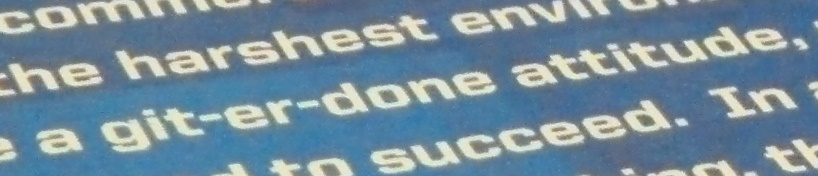
After visiting my folks I brought back a load of magazines to cut up for my classes. One of them was a diving magazine, and it contained an ad for an oil drilling company that was searching for divers to do industrial work:


Wait, did that actually say the ideal candidate will have "a git-er-done attitude"??


So this is what it's come to, eh? What a bunch of gits.


365: Picture a Day Project    365 Leftovers    All My Pictures    Sitzbook

Sitzbook: "Siddhartha"

Three of the four versions I have of this book. It's a bit worrying that I have
that many copies of one book. Isn't that the type of thing crazy people do?

When I first read Siddhartha it was assigned reading for an Asian Humanities class in high school. I really liked it, and I guess that proves that not everything that you have to read in school is awful. In fact, I counted it as one of my top 10 favorite novels, at least until recently, when I decided to give a few books a second read-through to see if they were as good as I remembered them to be. The book was still good, but maybe since it was actually one of the few books I'd read more than once (at least one additional time each in German and English), it didn't jump out at me or seem as special as it once had. It may also have something to do with the fact that for the first half of the book I was alternating between the English, German, and Spanish versions. It's kind of weird, but since I somehow had acquired all three (and a fourth free version on the Kindle, I later remembered), I wanted to take advantage of them. For the second half, though, I was more eager to take advantage of a long weekend to get ahead on my Sitzbook project, so I blazed through the English version so that I could check out the Hunger Games series.

Siddhartha still does have some nuggets of wisdom, though, so I mainly wanted to write this post to include a few of my favorite quotes from the book:


(p. 52) “Writing is good, thinking is better. Cleverness is good, patience is better.”

(p. 113) “’When someone is seeking,’ said Siddhartha, ‘it happens quite easily that he only sees the thing that he is seeking; that he is unable to find anything, unable to absorb anything, because he is only thinking of the thing he is seeking, because he has a goal, because he is obsessed with his goal. Seeking means: to have a goal; but finding means: to be free, to be receptive, to have no goal.’”

(p. 115) “Wisdom is not communicable. The wisdom which a wise man tries to communicate always sounds foolish […] Knowledge can be communicated, but not wisdom. One can find it, like it, be fortified by it, do wonders through it, but one cannot communicate and teach it.”


Well, that's it for today. If you've read or re-read this book, I'd love to hear your take on it. Thanks for reading, and have a great day!


365: Picture a Day Project    365 Leftovers    All My Pictures    Sitzbook

August 19, 2011

Danger!

I took this picture yesterday. It was on the wall of the classroom where I teach my evening class, presumably made by one of the students during the day class:


As you can see, it says, "I think I'm intelligent, I am responsable". If this drawing was actually made by a dolphin, I think I speak for all of humanity when I paraphrase The Onion and say: "Oh shit!"

365: Picture a Day Project    365 Leftovers    All My Pictures    Sitzbook

August 17, 2011

Pictures of the Day - June and July 2011

Well, I got really behind on posting Pictures of the Day, and that made me think: "There must be a better way." And by "better way," I of course mean "an easier way for a lazy person." It's a surprising amount of work to organize these Pictures of the Day, upload each picture, link the picture to its Flickr page, and then copy the description. If I did it one time, it'd be nothing, but I don't want to do it over 60 times. So, I'll try to use an embedded Flickr slideshow for each month. If you don't like this, can't see it, or have any comments, I'd appreciate them. I'm not even sure if anyone looks at or cares about these pictures, anyhow...

Here's June (click here to see in Flickr):


And here's July (click here to see in Flickr):


Once you click the "play" button, it's got all the standard controls, and if you want to see a description of any picture, click "show info" at the top. If you want to see any picture in more detail or check it out on Flickr, click on "show info" and then click on the picture's title.

So please, tell me what you think about this format. But so far, I'm liking it quite a bit! Thanks for reading. Have a good day!

365: Picture a Day Project    365 Leftovers    All My Pictures    Sitzbook

August 16, 2011

Sitzbook: "Blood Meridian"


I've been reading like a madman this last week: 4 books in 3 days, or 3 books in 2 days, or any other numerical comparison you'd like. As a result, I've gotten behind on a few other things, but I wanted to catch up a bit on Sitzbook with a quick quote from Cormac McCarthy's Blood Meridian. I borrowed this book from Lucy and she was right--the writing is excellent, although significantly denser than the only other book of his I've read, The Road. This one is also disturbingly violent and racist in a few sections, since it follows a group of people who go to Mexico to kill Indians in the 1850s. That's not a premise that's going to have a flowery style, I suppose. 

Still, the writing's really good. Check out this, from page 50:

"They rode through regions of particolored stone upthrust in ragged kerfs and shelves of traprock reared in faults and anticlines curved back upon themselves and broken off like stumps of great stone treeboles and stones the lightning had clove open, seeps exploding in steam in some old storm. They rode past trapdykes of brown rock running down the narrow chines of the ridges and onto the plain like the ruins of old walls, such auguries everywhere of the hand of man before man was or any living thing."

Wait: "Huh?" I often tell my students that since English has such a big vocabulary, native speakers often read books or newspaper articles without understanding every word. My students sometimes don't believe me, but indeed, there are at least a half dozen words that I don't recognize in this paragraph, and another three or four I'd be hard pressed to define. In fact, I just realized that I'm not even sure what "Blood Meridian" is supposed to mean. I imagine it's not got anything to do with the Prime Meridian and Greenwich Mean Time, but I'm not even certain about that. In any case, I guess the conclusion to this post is that the book is good and I'm a dumbass.

365: Picture a Day Project    365 Leftovers    All My Pictures    Sitzbook

August 10, 2011

Is Sitzman ABC Technically a Spin-off of Sitzblog?

Yesterday I decided to write a post on my language learning blog, Sitzman ABC, about naming customs and the differences between names in the U.S. and in Costa Rica. It turns out I bit off more than I could chew, because at about 2:30 am I had only finished the first half (about Costa Rica), and it was already long.

I'm only mentioning this because it actually seems more like the type of thing I'd put on this blog, since most of the people who read Sitzman ABC are my students, and they already know plenty about Costa Rican naming customs (Note: you're certainly more than welcome to follow Sitzman ABC directly or on Facebook, even if you're not Costa Rican!). I also noticed that this is a topic that has frequently come up in conversation with my friends and family in the U.S., who often think that Angela's last name is "Mora" (hint: it's not, but you'll have to read the article to find out why!).

As a result, I decided to re-post the article here. I think that's Kosher in terms of copyright and everything, since I wrote the article in the first place. So, without further ado, here's the article in its complete form:


Different Countries, Different Names: Costa Rica

The Jiménez Coat of Arms. Jiménez is one of the most common last names
in Costa Rica, and it's one of my wife's two last names. Image: Wikimedia

I've been wanting to write a post about naming customs in different countries, since it's a common conversation topic with my students and also with my friends and family back in the U.S. I know that this sometimes depends on the individual person and/or family, but from what I've noticed, names in Costa Rica and in the U.S. follow patterns, but they're different in a few important ways. Today we'll look at Costa Rican naming patterns, and in a few days we'll look at patterns in the U.S. If you have any observations, comments, or corrections, or if you're Costa Rican and your name follows a different pattern, I'd love to hear from you!

Names In Costa Rica

Almost everyone in the country has four names. There is a national ID card called a cédula for people over 18 years old, and the cédula generally has a person's four names. In normal social interactions, though, people often introduce themselves with only one or two names, or even a nickname. Let's look at an example of a typical female name in Costa Rica:

María Andrea Rodríguez Campos

(By the way, I just invented that name, but I would bet money that there's at least one woman in Costa Rica with that exact name!) So, in our example, María Andrea is this woman's name/s (nombre/s in Spanish). Since María is one of the most common first names in Costa Rica, it's often not mentioned, and sometimes it's abbreviated "Ma." as in "Ma. Fernanda." There aren't many "rules" for the two names, and parents usually choose to name a child after a relative, or they just choose a name that they think sounds good (even if it often doesn't!). Occasionally parents even give their children a third name, often related to religion. Common examples are (name 1) + (name 2) + de Jesús / de la Trinidad / de los Ángeles / del Carmen / etc. Oh, and a quick note: "María José" is a girl's name, and "José María" is a boy's name. That always caused me problems at first! 

In this example, Rodríguez Campos is the woman's last name/s (called "apellidos" in Spanish). This is where it gets confusing if you're not used to these naming customs. The first last name, "Rodríguez" in this case, is from the father. The second last name, "Campos," is from the mother. If María Andrea gets married later in her life, she will almost certainly not change her last names. Occasionally, especially in the past, a woman might add her husband's last name at the end after "de"; For example, if María Andrea married John Schneider, she could call herself "María Andrea Rodríguez Campos de Schneider," but this custom is pretty rare these days, at least in Costa Rica. You may have noticed, however, that the Argentinean President, Christina Fernández de Kirchner, followed this practice, so it may be more common in other countries or in certain situations.

A note: there are some very common last names in Costa Rica, such as Rodríguez, González, Jiménez, Araya, or Hernández; these are the "Smiths" and "Johnsons" of Central America, apparently! In some cases, a person's mother and father may have the same first last name, even if they're definitely from different families. If that happens, say with two parents with the first last name "Rodríguez," then their kids would simply be named "(name) + (name) + Rodríguez Rodríguez." 

As a result of these naming practices, in a hypothetical nuclear family consisting of a mom, a dad, a daughter, and a son, there would be three different last name combinations. The father would have his two last names, the mother would have her two last names, and the kids would both have the father's first last name followed by the mother's first last name. Does that make sense, or are you as confused as I was when I arrived here?

So how do you address a Costa Rican person? Well, if you're asking for someone on the phone or in person, it's common to ask for him or her using one or both names and the first last name. In our example, you'd ask for "María Andrea Rodríguez" if you didn't know her personally. If you knew her personally and knew that she preferred to be called "Andrea," then you might also ask for "Andrea Rodríguez." If it were an informal situation and you knew her personally --and you knew that she didn't object to the title-- you might possibly ask for "Doña Andrea," but this can also lead to problems. Doña (Don for men) is a title of respect paired with a person's first name, but it often is used only for older and/or married men and women. My wife Angela, for example, hates to be called "Doña Angela." I personally wouldn't mind being called "Don Ryan," since it makes me think of The Godfather's "Don Corleone" or the legendary lover "Don Juan," but the connotations aren't as positive or interesting with Doña. So be careful with that one!

As always, there are probably numerous exceptions to these rules, but from what I've noticed, the broad majority of Costa Ricans' names follow these patterns. Like I mentioned before, no matter where you're from, I'd love to hear any comments you might have about this article.

Thanks for reading, and in a couple of days we'll look at naming customs in the U.S.A. 
Have a great day!


365: Picture a Day Project    365 Leftovers    All My Pictures    Sitzbook

August 8, 2011

Colorado Trip Pictures

I've finished uploading pictures from our recent trip to Colorado. You can check them out here, and in a couple days I'll try to put up a pictorial post of the best pictures from the trip.

Sporty Angela

Thanks for reading. Have a good one!

365: Picture a Day Project    365 Leftovers    All My Pictures    Sitzbook

August 7, 2011

Wasted Years

It's interesting that a lot of thoughts, conversations, and social interactions I've been having lately have involved becoming older. It's mostly been a coincidence, though. In any case, in class yesterday one of my students did a presentation on heavy metal culture. It was pretty interesting, especially to see most of the classmates' reactions to the mere idea of heavy metal. Most assumed it was satanic, even without having heard any heavy metal ever before. At the end of the presentation the student played a song by Iron Maiden called "Wasted Years" and led an activity involving the lyrics. It was actually pretty spot-on in terms of what I've been thinking about lately, and while Iron Maiden does have their skeleton-corpse mascot Eddie, it's hard to argue that there's anything satanic or even dark about the lyrics to this song. In fact, it's pretty optimistic. Have a look at the video:


The general feeling of nostalgia can hardly be summed up better than through long-haired rockers wearing 80s-style short shorts and playing soccer. Here are the lyrics if you're interested:

IRON MAIDEN - WASTED YEARS

From the coast of gold, across the seven seas
I'm travelling on, far and wide
But now it seems
I'm just a stranger to myself
And all the things I sometimes do
It isn't me but someone else

I close my eyes and think of home
Another city goes by in the night
Ain't it funny how it is
You never miss it 'til it's gone away
And my heart is lying there
And will be 'til my dying day

(Chorus)
So understand
Don't waste your time
Always searching for those wasted years
Face up...make your stand
And realize you're living in the golden years

Too much time on my hands
I got you on my mind
Can't ease this pain, so easily
When you can't find the words to say
It's hard to make it through another day
And it makes me want to cry
And throw my hands up to the sky

(Chorus)

Well, that's it for now. Thanks for reading, and be sure not to waste your years!

365: Picture a Day Project    365 Leftovers    All My Pictures    Sitzbook